
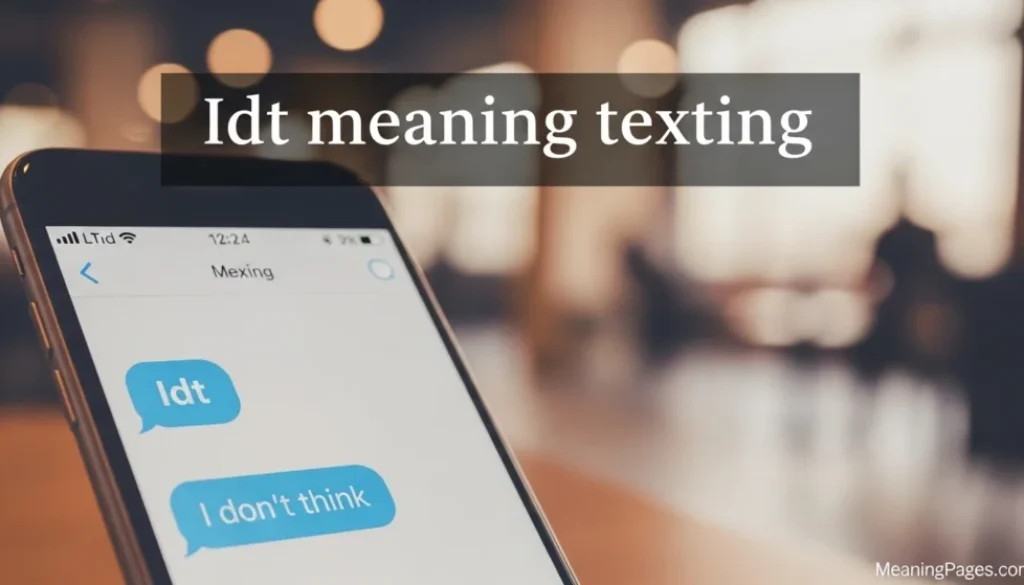
Idt meaning texting
A text message pops up on your phone, and you see someone write “IDT.” You pause for a second and wonder what it means. If that sounds familiar, you’re not alone. Many people come across texting shortcuts every day and feel confused about their meaning.
Texting has changed the way people communicate. Instead of writing full sentences, people often use short forms to save time. That’s why abbreviations like IDT are common on Snapchat, Instagram, TikTok, WhatsApp, and regular text messages.
If you’re trying to understand idt meaning texting, you’ve come to the right place. In this guide, you’ll learn what IDT means, when people use it, how to reply to it, and common mistakes to avoid. By the end, you’ll be able to recognize and use this abbreviation with confidence.
What Does IDT Mean in Texting?
IDT stands for “I Don’t Think.”
People use it when they want to share an opinion, express doubt, or politely disagree with something.
For example:
- “Are they coming tonight?”
- “IDT so.”
In this conversation, the person means:
- “I don’t think so.”
The abbreviation makes texting faster and easier, especially during casual chats.
Detailed Explanation of IDT
The phrase “I don’t think” is very common in everyday English. Since people often type quickly on their phones, they shorten it to IDT.
When someone uses IDT, they usually:
- Express uncertainty
- Share a personal opinion
- Politely disagree
- Show doubt about something
Unlike stronger responses such as “No” or “Absolutely not,” IDT often sounds softer and less direct.
Because of that, many people prefer using it during friendly conversations.
How IDT Is Used in Daily Texting
IDT appears in many different situations. Sometimes it shows uncertainty. Other times it simply reflects someone’s opinion.
Here are a few common examples.
Expressing Doubt
Someone may use IDT when they are not sure about something.
Example:
- “Will it rain later?”
- “IDT, the sky looks clear.”
The person believes it probably won’t rain.
Politely Disagreeing
IDT can help someone disagree without sounding rude.
Example:
- “This movie was boring.”
- “IDT it was boring. I liked it.”
Here, the person shares a different opinion in a friendly way.
Giving an Opinion
Many people use IDT before sharing their thoughts.
Example:
- “Should we leave now?”
- “IDT that’s a good idea.”
The speaker is giving their opinion about the situation.
Examples of IDT in Text Messages
Looking at real examples makes understanding easier.
Example:
- “Do you think she’s upset?”
- “IDT she is.”
Example:
- “Will the meeting start on time?”
- “IDT so.”
Example:
- “Should I buy this phone?”
- “IDT it’s worth the price.”
Example:
- “Are they open today?”
- “IDT they are.”
Example:
- “Can we finish everything today?”
- “IDT we’ll have enough time.”
As you can see, IDT fits naturally into many types of conversations.
Why People Use IDT Instead of Writing the Full Phrase
Texting is all about speed and convenience. People want to communicate quickly without typing long sentences.
That’s one reason why abbreviations have become so popular.
Using IDT:
- Saves typing time
- Makes messages shorter
- Feels casual and modern
- Works well in quick conversations
For instance, typing “I don’t think that’s true” takes much longer than simply writing “IDT that’s true.”
As a result, many people choose the shorter version.
Is IDT Formal or Informal?
IDT is considered an informal abbreviation.
People commonly use it in:
- Text messages
- Social media chats
- Online gaming
- Group conversations
- Messaging apps
However, it is usually not suitable for formal writing.
For example, avoid using IDT in:
- Business emails
- School assignments
- Professional reports
- Job applications
Instead, write the complete phrase “I don’t think.”
Informal Example
“IDT I’ll make it to the party.”
Formal Example
“I don’t think I will be able to attend the event.”
The second version sounds more professional and appropriate for formal communication.
Common Mistakes When Using IDT
Although IDT is simple, people sometimes use it incorrectly.
Let’s look at a few common mistakes.
Thinking It Means “I Didn’t”
Some people confuse IDT with “I didn’t.”
This is incorrect.
Correct meaning:
- IDT = I Don’t Think
Incorrect assumption:
- IDT = I Didn’t
Always remember that the “T” stands for “Think.”
Using It in Professional Writing
Another mistake is using IDT in formal situations.
For example:
- “IDT the proposal will work.”
This may seem unprofessional in a business email.
A better option would be:
- “I don’t think the proposal will work.”
Assuming Everyone Knows It
Not everyone understands texting abbreviations.
Therefore, consider your audience before using IDT.
If you’re talking to someone who rarely texts, writing the full phrase may be clearer.
Related: HMB meaning in text slang
Correct vs Incorrect Usage
Learning the difference between correct and incorrect usage can help avoid confusion.
Correct:
- “IDT he’s available today.”
- “IDT that’s the answer.”
- “IDT we should rush.”
Incorrect:
- “IDT means I didn’t.”
- Using IDT in formal reports.
- Assuming it always means “No.”
Remember, IDT usually expresses an opinion or doubt rather than a definite answer.
Similar Texting Abbreviations
Many texting shortcuts have meanings that are similar to IDT.
IMO
IMO means “In My Opinion.”
Example:
- “IMO, this restaurant is great.”
TBH
TBH means “To Be Honest.”
Example:
- “TBH, I expected more.”
IDC
IDC means “I Don’t Care.”
Example:
- “IDC where we eat.”
IKR
IKR means “I Know, Right?”
Example:
- “That movie was amazing.”
- “IKR!”
NVM
NVM means “Never Mind.”
Example:
- “NVM, I figured it out.”
Learning these abbreviations can make online conversations much easier to understand.
How to Reply When Someone Uses IDT
When someone sends a message containing IDT, your response depends on the situation.
If they are expressing doubt, you can ask for more details.
Example:
- “IDT he’ll come.”
- “Why do you think that?”
If they disagree with you, you can continue the discussion politely.
Example:
- “IDT that’s correct.”
- “That’s interesting. What’s your reason?”
In casual conversations, a simple response is often enough.
The key is understanding the context of the message.
Is IDT Popular on Social Media?
Yes, IDT is widely used across many social media platforms.
You may see it on:
- TikTok comments
- Instagram messages
- Snapchat chats
- Facebook Messenger
- Discord servers
- X posts
Young users often prefer abbreviations because they help conversations move faster.
Even so, people of all ages use texting shortcuts today.
When Should You Avoid Using IDT?
Although IDT is useful, there are times when writing the full phrase is a better choice.
Consider avoiding it when:
- Writing professional emails
- Communicating with teachers
- Preparing formal documents
- Speaking with clients
- Writing academic papers
In these situations, complete sentences create a more polished and professional impression.
Can IDT Have Other Meanings?
In most texting conversations, IDT means “I Don’t Think.”
However, some abbreviations can have different meanings in special industries or organizations.
When it comes to texting and social media, though, “I Don’t Think” is by far the most common meaning.
That’s the meaning most people will understand immediately.
Conclusion
Understanding idt meaning texting is actually quite simple once you know the abbreviation. IDT stands for “I Don’t Think” and is commonly used to express doubt, uncertainty, disagreement, or personal opinions in casual conversations.
You’ll often see it in text messages, social media chats, and online discussions. Because it saves time and keeps messages short, many people use it regularly. Still, it’s best to avoid IDT in professional or formal writing where full sentences are more appropriate.
Now that you know what IDT means, you’ll have no trouble understanding it the next time it appears in a conversation.
FAQs
What does IDT mean in texting?
IDT stands for “I Don’t Think.” It is used to express doubt, uncertainty, or an opinion.
Is IDT a slang term?
Yes. IDT is considered texting slang or an internet abbreviation commonly used in casual conversations.
Can IDT mean “I didn’t”?
No. In texting, IDT usually means “I Don’t Think,” not “I didn’t.”
Is IDT rude?
No. In fact, it often sounds more polite than directly saying “No” because it expresses an opinion rather than a firm rejection.
Where is IDT commonly used?
People frequently use IDT on Snapchat, Instagram, TikTok, WhatsApp, Discord, and regular text messages.
Should I use IDT in an email?
For professional emails, it’s better to write the full phrase “I don’t think” instead of using the abbreviation IDT.
What is an example of IDT in a sentence?
A simple example is:
“Will they arrive today?”
“IDT so.”
This means, “I don’t think so.”
Iys meaning text slang - Meaning Pages
June 10, 2026 @ 3:53 pm
[…] Related: Idt meaning texting […]